


Table of Contents:
- Bargaining Resumes September 9
- A Decade of Disproportionate Growth: uOttawa Upper Central Administration, Student Population and APUO Minimum Staffing Complement
- Runaway Student-to-Professor Ratios: uOttawa by the Numbers
- Progressive Victories: APUO Minimum Staffing Complement
- Take Action
Bargaining Resumes September 9
The Employer and the APUO negotiating teams recently completed six full days of intensive, in-person bargaining. The tone of these meetings remains positive, and the parties engaged in in-depth discussions on several key issues, including expanding measures to help retain equity-deserving members and improving terms and conditions of work for Academic Librarians.
For the first time in recent rounds of bargaining, the parties are also having productive discussions on transparency and governance. While this represents meaningful progress, several difficult issues remain unresolved, including:
- Ensuring transparency, participation, and accountability in university decision-making (collegial governance);
- Workload and the minimum number of full-time professors and librarians (staffing complement)
- Guaranteeing a space for childcare on campus; and
- Establishing safeguards to ensure that the adoption and use of artificial intelligence respects members’ rights, academic freedom, and working conditions.
The APUO will table its financial proposals by mid-September. These proposals will subsequently be presented to the Board of Governors.
Negotiations will resume on Wednesday, September 9, with half-day bargaining sessions scheduled weekly thereafter.
A Decade of Disproportionate Growth: uOttawa Upper Central Administration, Student Population and APUO Minimum Staffing Complement
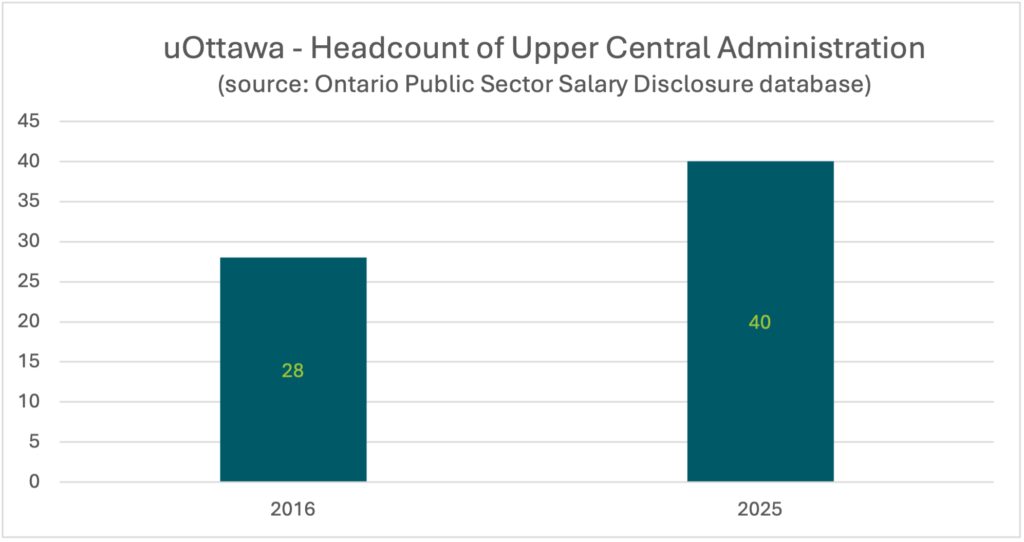
The minimum number of full-time professors and librarians (APUO staffing complement) has consistently been identified by members as a major priority over more than a decade yet continues to experience the lowest rate of growth compared to that of uOttawa’s upper central administration and our student population. A conservative analysis1 of growth within the upper central administration shows that since 2016, the number of positions within the upper central administration grew from 28 to 40. These figures include President, Vice-Presidents and Associate Vice-Presidents, Vice-Provosts and Associate Vice-Provosts, Chiefs of Staff, the Registrar and Associate Registrar, Chief Officers and the legal team. We did not include Deans and Vice-Deans in our analysis.
Meanwhile, uOttawa’s student population growth has steadily outpaced that of full-time professors and librarians since 2016. All three areas of growth on campus over the past decade are summarized in the table below:
| 2016 | 2025 | % of Growth | |
| Student Population | 41 882 | 48 110 | 14.87% |
| APUO Minimum Complement | 1311 | 1335 | 1.83% |
| Upper Central Administration | 28 | 40 | 42.86% |
The numbers tell a clear story. While uOttawa’s student population has grown by nearly 15% since 2016, the APUO minimum complement has increased by less than 2%. At the same time, the University’s upper central administration has grown by almost 43%. The result is a university where APUO members are being asked to do more with fewer resources (as you will see below, our student-to-professor ratios have considerably deteriorated since 2016), while administrative growth continues at a much faster pace.
This is why the APUO minimum staffing complement remains a critical priority at the bargaining table. A fair complement is essential to protecting the quality of education and research while ensuring fair workloads.
Runaway Student-to-Professor Ratios: uOttawa By the Numbers
As in previous rounds, the APUO has analysed uOttawa’s student-to-professor2 ratio, and there is considerable deterioration. The disproportionate growth of uOttawa’s student population compared to that of full-time professors and librarians has resulted in ever-increasing student-to-professor ratios.3 With uOttawa having surpassed 50 000 enrolled students, our current student-to-professor ratio sits at 37.5:1, up from 31.9:1 a decade ago and a far cry from the University’s Vision 2020 goal of improving the student-to-professor ratio to 18.5:1.4
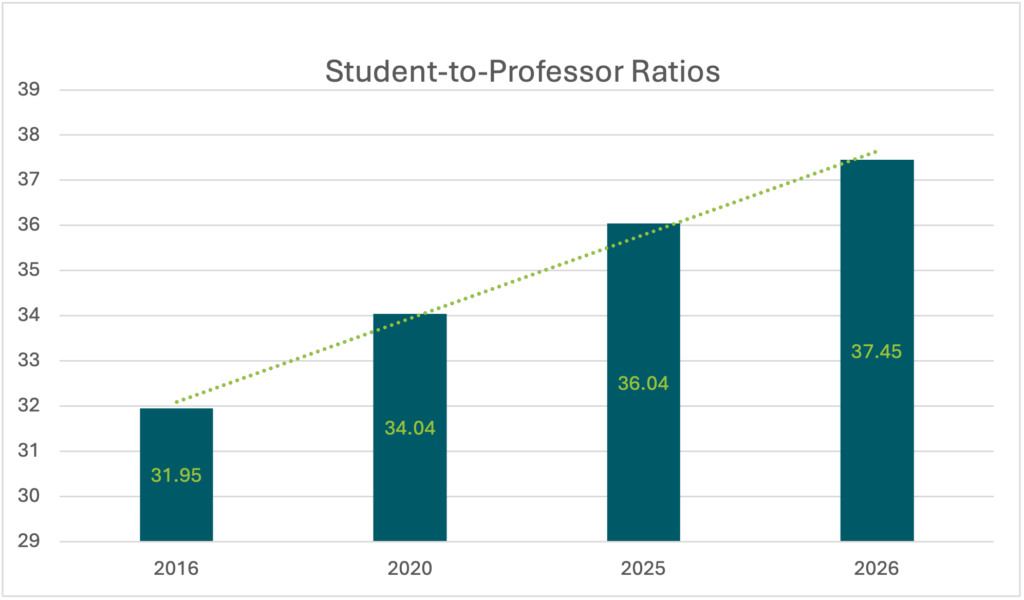
2023-2024 is the last year for which validated data5 about student-to-professor ratios are available at the provincial6 and national7 levels. Based on this data, here are the student-to-full-time faculty (FTF) averages, along with uOttawa’s ratio8 from that same year:
- 33 to 1 – Ontario universities
- 25.3 to 1 – Canadian universities
- 36 to 1 – University of Ottawa
Across all metrics uOttawa’s student-to-professor ratio falls short of internal goals and provincial and national averages. We need new full-time faculty and librarian positions to support the University’s teaching and research mission, to be able to maintain collegial governance, and to address the growing bureaucratic burden.
Progressive Victories: APUO Minimum Staffing Complement
Historically, members’ unity on the issue of the APUO minimum staffing complement has led to progressive victories in successive rounds of bargaining. Since the negotiation of the 2012-2016 Collective Agreement, the APUO has successfully negotiated Letters of Understanding committing the Employer to a minimum staffing complement. In 2025, as a result of members’ participation in a majority petition (74%) and strike vote (81% in favour), we secured language formalizing the complement of 1335 APUO positions in Article 17.10 of the 2024-2026 Collective Agreement. The APUO is one of the rare academic unions in Canada having made such gain.
This was a major victory, and the APUO’s Negotiation Team is now focused on negotiating higher minimum staffing complement numbers to ensure fairer workloads for members and higher quality education for students.
In order to win gains in complement, we must be able to demonstrate resolve and unity around this key issue. Join colleagues in showing your commitment by filling out a commitment card here. You can sign until September 17.
Keep an eye out for more bargaining updates in coming weeks.
1. Analysis conducted using the 2016 and 2026 Ontario Public Sector Disclosure database to identify senior administrators at the University of Ottawa.
2. NOTE: The APUO complement number, and therefore the uOttawa ratio, includes librarians.
3. Ratios were calculated using uOttawa’s reported enrolment numbers and the APUO’s complement numbers as agreed upon in Letters of Understanding and the 2024-2026 Collective Agreement. In instances where conflicting enrolment amounts were reported by uOttawa for the same year, we used the lower of the two numbers. It is worth noting that the University of Ottawa stopped publishing data about student-to-professor ratios in 2017.
4. University of Ottawa’s Institutional Research and Planning, Destination 2020 Scorecard, 2010, p. 3
5. Sourced from the Ontario Confederation of University Faculty Associations (OCUFA) based on Statistics Canada data.
6. Provincial data excludes medical-dental faculty and includes ranks below assistant professor and those with senior administration roles such as Dean.
7. National data includes fulltime academic personnel at all ranks, including below assistant professor.
8. uOttawa’s ratio is calculated using uOttawa’s reported enrolment numbers and the APUO’s complement numbers, which include full-time professors and librarians, as agreed upon in Letters of Understanding and the 2024-2026 Collective Agreement. In instances where conflicting enrolment amounts were reported by uOttawa for the same year, we used the lower of the two numbers.